Social Currant
3-5 minutes
The Comment Section is an Organizing Tool
Partnership Report
Organizations
Immigratiton
Comment Analysis
Topic Modeling
Healthcare
Comment Section
When we published our new Partnership Report with the National Immigration Law Center (NILC) a couple weeks ago, much of the attention went to the numbers people expect to see: 3.9 million views, 233,000 engagements, and 5,000+ petition signatures. Those numbers are meaningful! But the finding we kept coming back to was actually in the comment section.
We analyzed 1,727 comments across two NILC campaigns: the Health for All campaign, which ran from August through October 2025, and the rapid-response effort around Jackie Merlos’s detention. There were 1,487 unique commenters and over 26,600 combined likes. And nearly 60% of those comments were substantive, averaging around 16 words each.
If you spend any time on social media, you know that’s not always the case. Most comment sections are a mix of emoji reactions, one-word responses, and the occasional argument. What we found in these two campaigns tells a story about what creator-led advocacy can actually accomplish when it’s built the right way.
Two Campaigns, Two Different Comment Behaviors
The Health for All campaign was designed to reach healthcare workers and educate them about why sensitive medical spaces are no place for ICE enforcement. The comment section not only confirmed it was working, but it went further than we expected.
Nurses were telling other nurses exactly what to say when ICE agents showed up. Healthcare workers were sharing protocols, demanding training, and tagging colleagues who needed to see the content. The creators hadn’t asked them to do any of that. Instead, the content gave people a shared language and a reason to organize – and they ran with it.
"I work at a hospital in LA… My dept demanded info. Push for system-wide mandatory trainings."
♥ 408 likes
"As a nurse I'm sending this to my whole unit. We need to know our rights and our patients' rights."
♥ 217 likes
The Jackie Merlos campaign comment section looked different and was just as remarkable. When creator content about Jackie’s detention went live, the comment sections became something closer to a live coordination hub. 140 comments were specifically about the petition: people asking for the link, confirming they’d signed, updating each other Jackie’s status in real time. Strangers who had never met were holding each other accountable to act.
"Update Jackie has been released but Carlos is still in custody. Still need signatures."
♥ 1,279 likes — the single most-liked comment across both campaigns
"Signed and shared. Everyone please keep the pressure on — this family needs us."
♥ 341 likes
That top comment, an organic update from a stranger, helped keep the pressure alive even after Jackie came home, redirecting attention to her husband Carlos who was still detained. The comment section had developed its own momentum.
Why This Matters for How We Measure Creator Campaigns
The standard metrics for campaigns tell you how many people saw the content and whether they reacted to it. But they don’t necessarily tell you what people do next. Which, in advocacy, is the whole point.
Comment section analysis gives us a window into something that is difficult to capture: whether content actually moves people, what it moves them to do, and whether the right communities are seeing the posts. In the Health for All campaign, the comment section told us healthcare workers were consuming the content and using it to organize within their own institutions. In the Jackie Merlos campaign, it told us that strangers were coordinating around a concrete action in real time.
What We’re Building From Here
At Social Currant, we’re going deeper on comment section analysis across our campaigns – moving beyond sentiment analysis into topic modeling that helps us understand not just what audiences are saying, but how well it aligns with what a campaign is trying to accomplish. Which messages are landing? Which are generating the most emotionally engaged responses? Where is the conversation going that we didn’t expect?
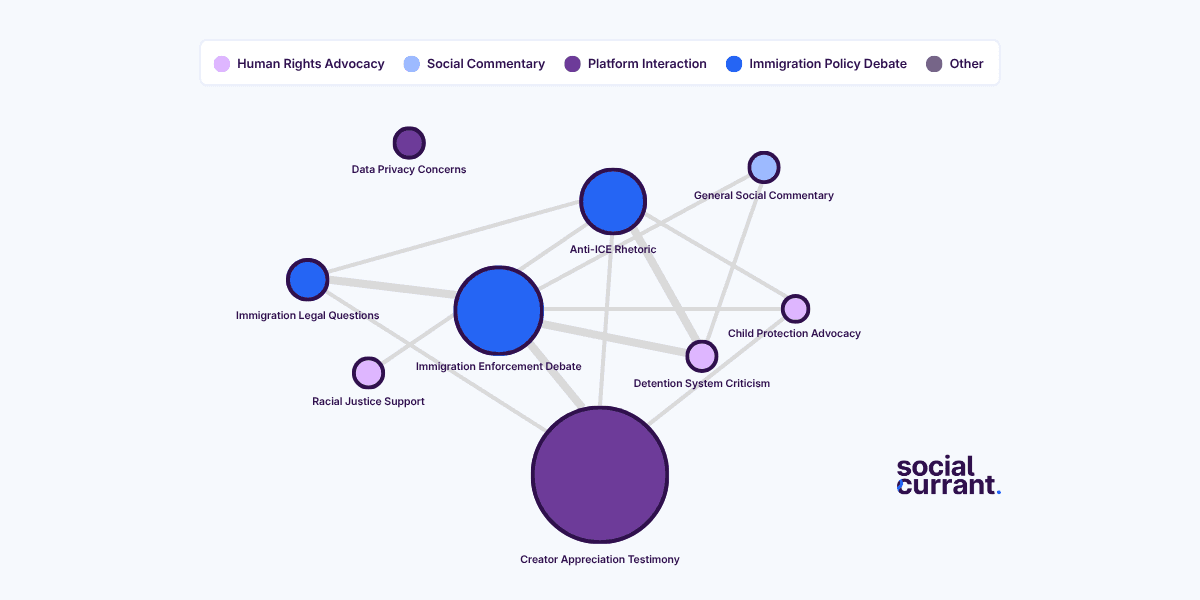
The comment section is one of the richest sources of real-time audience data available to advocacy organizations right now. The NILC campaigns showed us what’s possible when you treat it as a signal rather than noise. That’s what good creator work looks like in practice and we believe it's worth measuring.
Want to see the full data? Read the full Partnership Report with the National Immigration Law Center